Connect this guide with the rest of your visit in the Lahore trip planner. Read how the research is made and what its sources establish.
At a glance
Start here
- Shalamar's terraces joined court hierarchy to a controlled water system.
- Pavilions, planting and reflected views made political order sensory rather than abstract.
- Hazuri Bagh used a garden and central baradari to stage Sikh-period courtly power.
- Modern municipal parks shift emphasis toward maintenance, public facilities and citywide green space.
01
A garden is a system before it is a view
The postcard shows flowers and fountains; the system includes land gradient, channels, walls, labour, planting cycles, repair and rules of movement. Someone decides where water enters, which path commands the longest axis and which pavilion receives the privileged viewpoint. Beauty is the visible surface of coordinated resources.
This systems lens avoids two weak readings: treating every old garden as an earthly paradise with no politics, or treating every public park as empty leisure land. Ask instead what had to be controlled, maintained and funded to make the landscape appear calm.
02
Shalamar builds rank into levels
The federal archaeology record describes Shalamar as a terraced, walled garden laid out in 1642 at Shah Jahan's command for royal recreation and accommodation during visits to Lahore. It identifies buildings on the upper terrace with imperial rest, public-private audience and the empress's residence. Space was therefore differentiated by court function rather than offered as a neutral lawn.
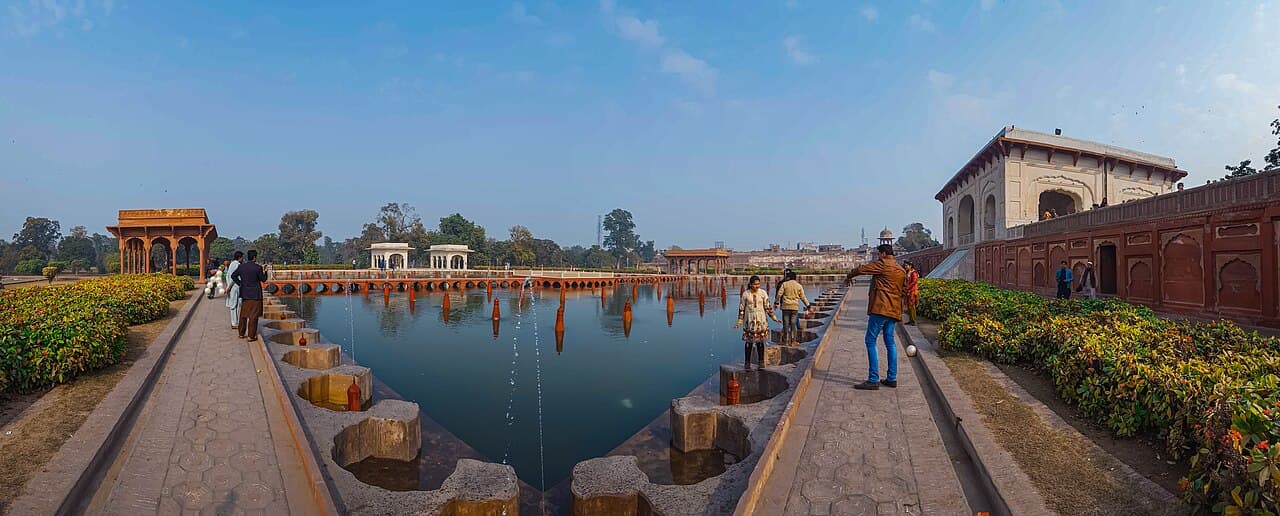
TDCP names the descending terraces Farah Bakhsh, Faiz Bakhsh and Hayat Bakhsh. Its brochure associates the upper level with the royal family, the middle with fruit trees, seasonal flowers, pavilions and a throne, and the lower with fruit and shade trees. Whether or not every planting survives, the documented scheme ties altitude, access and use together.
Sources: Department of Archaeology and Museums, Government of Pakistan; Tourism Development Corporation of Punjab03
Water performs control
TDCP's account says a canal called Shah Nahar supplied the gardens and describes canals, tanks, cascades and fountains distributed through the terraces. The naturally stepped site helped the designers organise flow. Water did practical work, but it also produced sound, reflection, movement and a visible impression of abundance.
Follow one channel with your eyes rather than chasing every fountain. Where does the surface widen into a tank? Where is a cascade displayed beside a pavilion? Which view would have aligned water with a seated ruler or guest? These questions treat hydraulic design as political theatre without claiming that every feature operates now.
Sources: Tourism Development Corporation of Punjab; Department of Archaeology and Museums, Government of Pakistan04
Planting controls time as well as space
The official brochure differentiates fragrant shrubs and flowers on the upper terrace, fruit trees and seasonal flowers in the middle, and fruit and shade trees below. Plant categories supplied scent, harvest, colour and shelter on different calendars. A garden's programme therefore unfolded across hours and seasons even when its masonry stayed fixed.
For a present-day reading, separate documented intention from what is visibly growing. Do not name a tree from memory or assume a flowerbed reproduces a seventeenth-century plan. Record shade density, scent, fruit, clipped form and volunteer growth, then consult labels or staff where available. The gap between design record and living landscape is part of garden history.
Sources: Tourism Development Corporation of Punjab05
Hazuri Bagh compresses a court into a threshold
WCLA places Hazuri Bagh beside Roshnai Gate, between the Lahore Fort and Badshahi Mosque precinct. Its gate history says Maharaja Ranjit Singh built the garden in 1813 to celebrate acquiring the Koh-i-Noor from Shah Shujah and identifies the baradari at its centre. The same authority notes that Ranjit Singh used the pavilion for court.
Unlike Shalamar's extended terraces, Hazuri Bagh works as a compact field among existing monumental powers. A central pavilion could claim a new political presence while borrowing the visual weight of the surrounding Mughal ensemble. The garden is not empty space between monuments; it changes their relationship.
Sources: Walled City of Lahore Authority; Walled City of Lahore Authority06
Municipal parks change the public contract
PHA describes its role as developing and maintaining parks and green areas across Lahore. Its engineering directorate lists boundary treatments, hard landscaping, irrigation, lighting, benches, bins, tree guards, fountains, play items, fitness units, toilets and drinking-water infrastructure among the works it maintains. This vocabulary is different from a royal garden record: it centres service systems and recurring upkeep.
That does not make modern parks politically neutral. Maintenance choices determine which facilities function, where shade develops and how different users share space. Public leisure depends on recurring administration as much as planting, and an official list of assets should never be mistaken for proof that every one works on a particular day.
Sources: Parks and Horticulture Authority Lahore; Parks and Horticulture Authority Lahore07
Read a Lahore garden without romanticising it
Begin with the water source, gradient and enclosure. Then identify the most privileged viewpoint and the ordinary circulation route. Notice labour indirectly through trimmed edges, repaired channels, bins, guards and closed areas. Finally ask who the original landscape served and who the current institution says it serves.
Avoid turning decay into charm or active maintenance into visual clutter. Both are evidence of the pressures placed on a living landscape. Shalamar, Hazuri Bagh and a municipal park should not be collapsed into one timeless City of Gardens image; their different systems reveal changing contracts among power, pleasure and public space.
Useful answers
Reader questions
Was Shalamar Gardens designed as a public park?
The official archaeology record describes it as a royal recreation and accommodation landscape created for Shah Jahan. Its present heritage use is a later chapter, so historical court function should not be confused with today's visitor experience.
Sources: Department of Archaeology and Museums, Government of PakistanWhy do Shalamar's three terraces matter?
They combine water flow, views, planting and differentiated court functions. TDCP names the terraces and associates each with distinct buildings or plant categories, making vertical order central to the garden's design.
Sources: Tourism Development Corporation of PunjabWhat connects Hazuri Bagh to Sikh rule?
WCLA dates the garden to Ranjit Singh's period, connects it with the Koh-i-Noor episode, and says the central baradari was used for court. Its position among older monumental spaces amplified that claim.
Sources: Walled City of Lahore Authority; Walled City of Lahore AuthorityWhat does PHA actually maintain in Lahore parks?
Its engineering page lists landscape, irrigation, lights, benches, bins, fountains, play and fitness items, toilets and drinking-water infrastructure among its responsibilities. This is an agency description, not a guarantee that every facility works at every park.
Sources: Parks and Horticulture Authority LahoreRead the evidence
Sources and further reading
These sources support the relevant sections above. Plans and comparisons are editorial suggestions. Check operators for current arrangements.
- Shalamar Gardens: A World Heritage Site ↗Tourism Development Corporation of Punjab · Research date 14 September 2026
Terrace names, planting, water system, pavilions and historic court uses at Shalamar.
- Shalamar Garden ↗Department of Archaeology and Museums, Government of Pakistan · Research date 14 September 2026
Date, patronage, royal purpose, terracing, canals and principal structures.
- Historic Gates of Lahore: Explore the Walled City Entrances ↗Walled City of Lahore Authority · Research date 14 September 2026
Hazuri Bagh's location, date, baradari and relationship with Roshnai Gate.
- Explore Monuments of Walled City Lahore: Heritage Sites ↗Walled City of Lahore Authority · Research date 14 September 2026
Ranjit Singh's use of the Hazuri Bagh pavilion as a court.
- What We Do | Parks and Horticulture Authority ↗Parks and Horticulture Authority Lahore · Research date 14 September 2026
PHA's stated development and maintenance role for Lahore parks and green areas.
- Engineering | Parks and Horticulture Authority ↗Parks and Horticulture Authority Lahore · Research date 14 September 2026
The park structures, utilities and facilities listed under PHA engineering maintenance.