Connect this guide with the rest of your visit in the Lahore trip planner. Read how the research is made and what its sources establish.
At a glance
Start here
- The Lahore Resolution was adopted at Minto Park on 23 March 1940.
- Minar-e-Pakistan was completed later, in 1968, to mark that event site.
- 23 March also became Republic Day after Pakistan's 1956 Constitution took effect.
- Museum photographs, stamps and public monuments turn a political episode into different kinds of civic memory.
01
One date holds two state moments
The National Assembly's constitutional history says the Pakistan Resolution was adopted at Minto Park, Lahore, on 23 March 1940. It also records that Pakistan's 1956 Constitution took effect on 23 March, making the country an Islamic Republic and the date Republic Day. Public commemoration therefore joins a pre-independence political resolution with a post-independence constitutional change.
Keeping those events separate makes the memory stronger, not weaker. One concerns a political demand articulated under colonial rule; the other concerns the constitutional form of an existing state sixteen years later. The shared date creates a bridge that annual observance can repeatedly cross.
Sources: National Assembly of Pakistan02
The monument came after the event
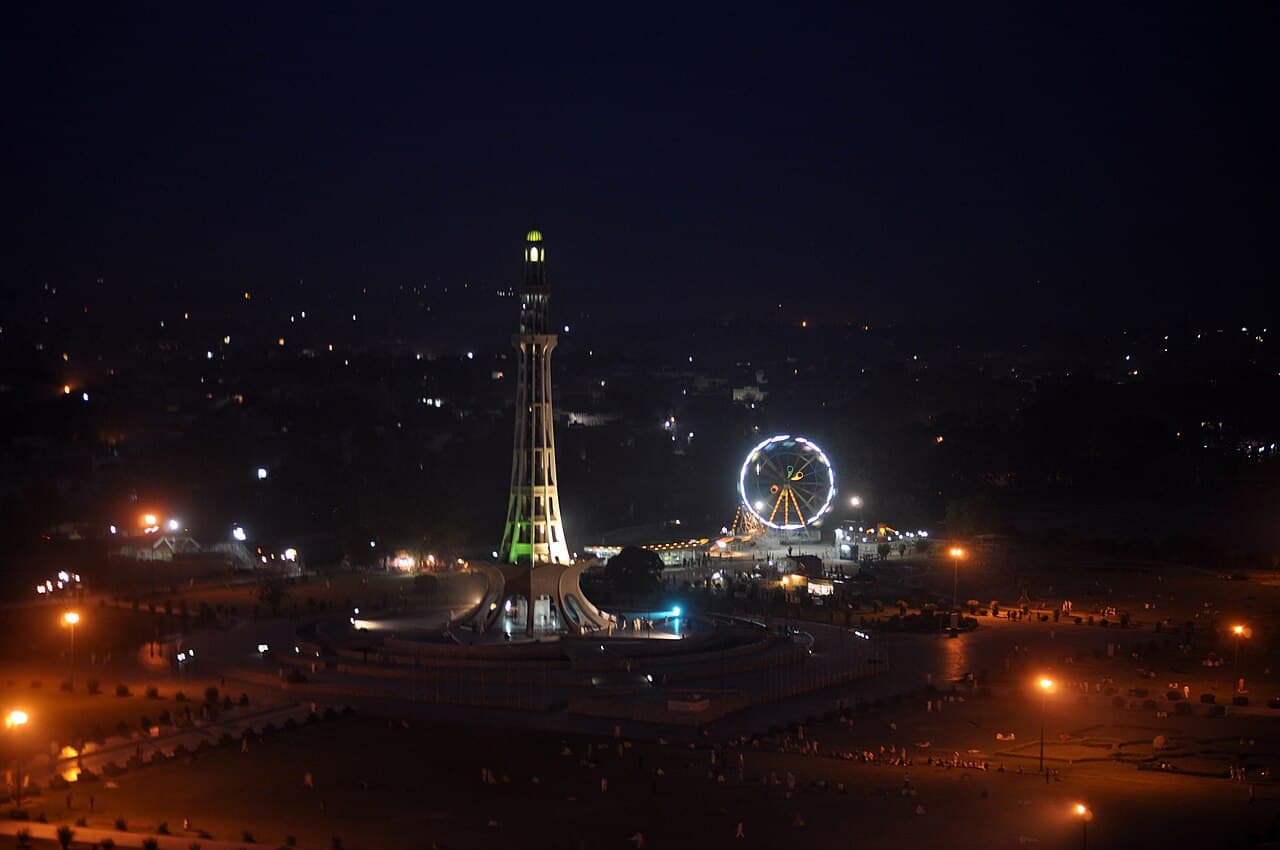
WCLA's Greater Lahore monument page states that Minar-e-Pakistan marks the site of the Lahore Resolution and was completed in 1968. That interval matters: the gathering and resolution did not occur beneath the finished minaret. The later structure gave a past political event a permanent vertical marker in the city.
This distinction offers a simple way to read any memorial. Ask what happened at the site, who later decided it needed a monument, and how the completed form guides attention. Minar's height makes the memory visible from a distance; the park gives the marker room to be approached, circulated around and incorporated into public gatherings.
Sources: Walled City of Lahore Authority03
A park turns history into ground
Calling the location only a monument misses the landscape. The resolution is remembered through a relationship among ground, tower and surrounding heritage precinct. A visitor can occupy the same broad site without reproducing the 1940 assembly. Public memory works through that physical continuity even when buildings, planting, circulation and management have changed.
Read the landscape as part of the memorial: where can the tower first be seen, what frames its outline, and how does its scale change as you approach? These are questions about the relationship between a remembered event and its later setting. They do not require assumptions about who currently manages the park or which facilities are operating.
Sources: Walled City of Lahore Authority04
The museum builds a sequence
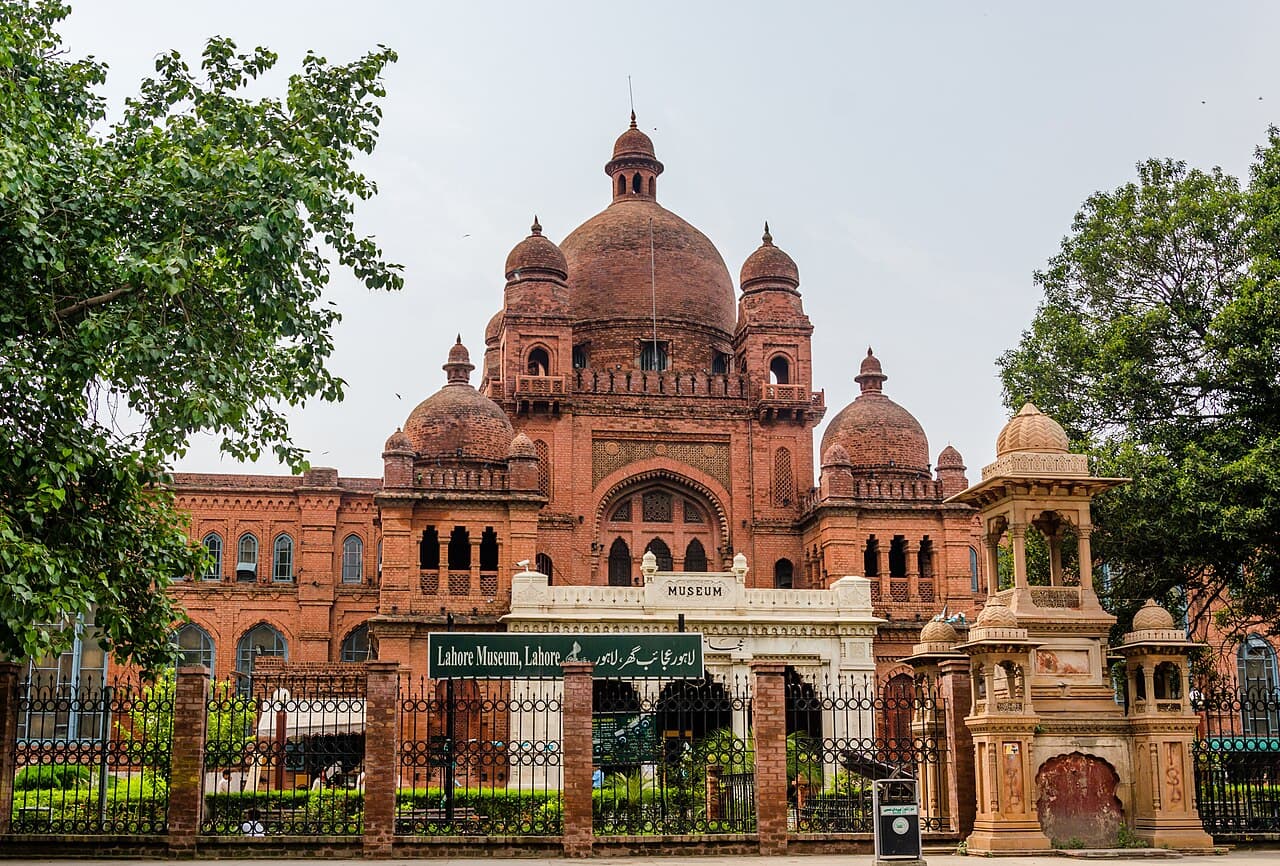
Lahore Museum's Pakistan Movement Gallery uses black-and-white photographs to present people and events from the eighteenth century to 1947. Its official description places the Lahore Resolution within a sequence that includes the Aligarh and Khilafat movements, the founding of the All-India Muslim League, the Indian Independence Act and migration, with dedicated attention to Muhammad Ali Jinnah and Allama Iqbal.
A gallery sequence does different work from a tower. The monument singles out a site and event; the museum embeds the event among causes, organisations, leaders and consequences. Its chronological arrangement invites visitors to see progression, while the selection of photographs also reminds us that archives never show everything.
Sources: Lahore Museum, Government of Punjab05
Stamps shrink the state image
The museum's Postage and Stamps Gallery records Pakistan's early postal issues and identifies the first regular series issued for the first anniversary of independence in 1948. Those stamps used images including the crescent and star, the scale of justice, infrastructure and state buildings. A stamp turns official imagery into something handled, cancelled, collected and sent.
This is public memory at a different scale. Minar-e-Pakistan asks bodies to move through a monumental landscape; a stamp makes state symbols travel on paper. The comparison reveals why commemoration cannot be reduced to architecture. Repeated small images may circulate more widely than a landmark, even though the landmark dominates the skyline.
Sources: Lahore Museum, Government of Punjab06
Official language renews the event
A 2026 National Assembly message describes the Lahore Resolution as foundational to the creation of an independent state and uses 23 March to call for unity and responsibility. Such statements are not neutral transcripts of the 1940 meeting; they are contemporary acts of commemoration that connect a selected past to present civic goals.
Read this language alongside, not instead of, the monument and gallery. Which words recur each year? Which historical actors are foregrounded? Which current values are attached to them? Public memory remains active because institutions repeatedly interpret the event for new circumstances.
Sources: National Assembly of Pakistan07
Read the memorial in four scales
At the landscape scale, note how the tower occupies the park. At the building scale, identify changes in material and form without inventing symbolism. At the gallery scale, see what comes immediately before and after the Resolution photographs. At the handheld scale, compare stamps or printed reproductions that circulate state imagery.
Then write four dates in order: 1940 resolution, 1947 independence, 1956 constitution, 1968 monument completion. That small chronology blocks the most common confusion and leaves room for deeper questions about political language, constitutional change and commemoration. Any visit details, access conditions or event arrangements should come from current responsible authorities, not from this historical essay.
Sources: National Assembly of Pakistan; Walled City of Lahore AuthorityUseful answers
Reader questions
Was Minar-e-Pakistan standing when the Lahore Resolution passed?
No. The resolution was adopted at Minto Park in 1940, while WCLA dates the monument's completion to 1968. The minaret is a later memorial marker for the event site.
Sources: National Assembly of Pakistan; Walled City of Lahore AuthorityWhy is 23 March also connected to Pakistan's Constitution?
The National Assembly records that the 1956 Constitution took effect on 23 March and Pakistan became an Islamic Republic. The national date therefore links the 1940 resolution and the 1956 constitutional change.
Sources: National Assembly of PakistanHow does Lahore Museum present the Resolution?
Its Pakistan Movement Gallery places photographs of the Lahore Resolution inside a chronological display of movements, organisations, leaders, independence legislation and migration extending to 1947.
Sources: Lahore Museum, Government of PunjabWhy discuss stamps in an article about Minar-e-Pakistan?
Because public memory travels at multiple scales. The museum's postal collection shows how early Pakistan circulated state symbols through small printed objects, while the minaret anchors memory to one monumental landscape.
Sources: Lahore Museum, Government of PunjabRead the evidence
Sources and further reading
These sources support the relevant sections above. Plans and comparisons are editorial suggestions. Check operators for current arrangements.
- The Constitution of 1956 ↗National Assembly of Pakistan · Research date 14 September 2026
The 23 March 1940 Minto Park resolution and the 23 March 1956 constitutional commencement.
- Explore Lahore's Historic Monuments in the Walled City ↗Walled City of Lahore Authority · Research date 14 September 2026
Minar-e-Pakistan's event-site association and 1968 completion.
- Pakistan Movement Gallery | Lahore Museum ↗Lahore Museum, Government of Punjab · Research date 14 September 2026
The photographic gallery's chronology, Resolution material and named movement themes.
- Postage & Stamps Gallery | Lahore Museum ↗Lahore Museum, Government of Punjab · Research date 14 September 2026
The dates, subjects and circulation context of Pakistan's early postage-stamp series.
- NA Speaker Sardar Ayaz Sadiq Marks 23rd March as a Day of Unity, Sacrifice, and National Resolve - March 22, 2026 ↗National Assembly of Pakistan · Research date 14 September 2026
An official 2026 example of contemporary commemorative language around the Resolution.