Connect this guide with the rest of your visit in the Lahore trip planner. Read how the research is made and what its sources establish.
At a glance
Start here
- The museum and art school developed through shared people, purposes and adjacent sites.
- Tollinton Market preserves the memory of an industrial-arts exhibition before the current museum opened.
- Punjab University and GCU made higher education physically visible near the civic core.
- The corridor is best understood as an institutional network, not a collection of isolated landmarks.
01
A civic corridor is made by circulation
Institutions cluster because people, objects and authority circulate among them. A museum needs collectors, cataloguers and trained makers; an art school needs examples, workshops and patrons; a university needs halls where knowledge becomes a public claim. On the Mall, these functions appeared close enough to share designers, administrators, students and visual language.
The result is not one master plan with a single date. It is an accumulation. Reading it requires moving between institutional records: where a collection was housed, when a college moved, who designed a building, and which older structure was adapted to a new public use.
02
The museum moved before it became monumental
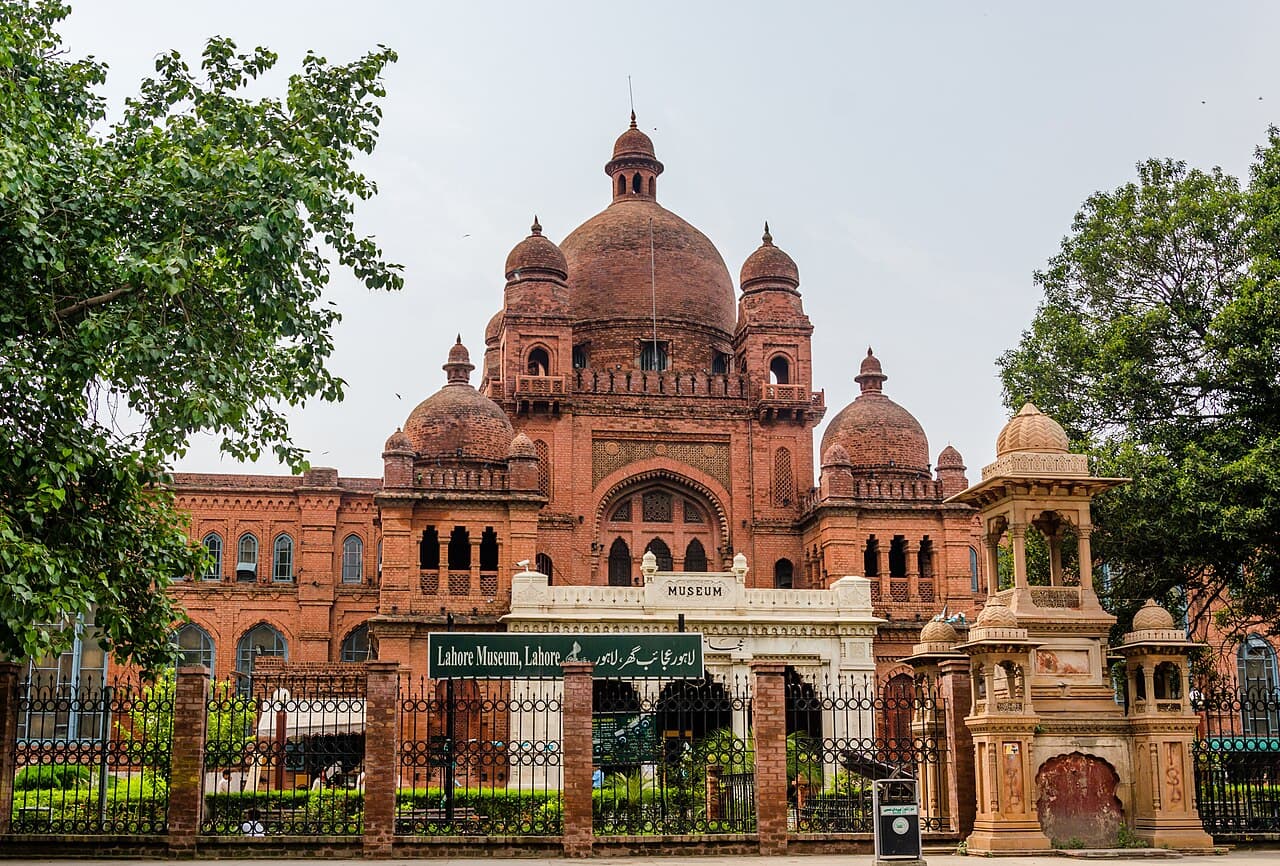
Lahore Museum's own background begins before the present red-brick building. Wazir Khan's Baradari served as an early museum location. The collection then moved to the hall built for the Punjab Exhibition of Industrial Arts and Crafts in 1864, later known as Tollinton Market. Only in 1894 did it enter the present Central Museum Punjab building.
That migration matters. A baradari, an exhibition hall and a purpose-built museum imply three different ideas of public knowledge: adapted pavilion, temporary industrial display and permanent classified collection. Tollinton's later life as a market did not erase its exhibition origin; it made the corridor's institutional history visible through reuse.
Sources: Lahore Museum, Government of Punjab04
Zamzama disrupts the educational scene
A cannon outside a museum and art school prevents the precinct from becoming a gentle story of culture. The museum dates Zamzama's casting in Lahore to around 1757 and traces its movement through Afghan, Bhangi Sikh and Ranjit Singh's possession before its display in front of the museum and NCA. It is both an object with a violent history and a famous urban marker.
Its position changes how the ensemble reads. Knowledge institutions did not float above struggles for territory and possession; they classified objects produced by those struggles. The cannon's scale, material and outdoor placement create a counterpoint to coins behind glass and decorative arts in teaching collections.
Sources: Lahore Museum, Government of Punjab05
Universities gave knowledge a skyline
The University of the Punjab was established in Lahore in 1882. Its official introduction places the Allama Iqbal Campus on Mall Road and connects it with the Oriental College, whose institutional precursor dates to 1870. A separate campus page identifies the historic Senate Hall, Syndicate Room and Main Hall there. The language of halls and senate makes governance itself architectural.
Government College followed a different path. Its building history says the college opened in 1864 in a Walled City haveli, moved through sites near Anarkali, and occupied the present building in the 1870s. The move from borrowed domestic space to a prominent academic building mirrors the larger corridor's shift toward visible, durable institutions.
Sources: University of the Punjab; University of the Punjab; Government College University Lahore06
An older baradari remained in the network
The story is not simply Mughal city replaced by colonial institutions. Wazir Khan's Baradari, built as the centre of a seventeenth-century garden, became an early museum and later a reading room associated with Punjab Public Library. WCLA places it between the library, NCA and Lahore Museum and notes the concentration of literary and educational institutions around it.
Adaptation is the connecting process. A garden pavilion became museum and reading room; an exhibition hall became market and heritage institution; a craft school became NCA; colleges became universities. The Mall's civic identity was produced as much by reuse as by new construction.
Sources: Walled City of Lahore Authority; Lahore Museum, Government of Punjab07
Read the road as an argument, not a backdrop
From public space, compare how each institution meets the road. Is the entrance immediate or set back? Does a tower, dome, sign or wall claim attention? Which object is placed outside, and which histories remain inside? Then compare the official institutional story with what the street makes visible. Gaps between the two are analytically useful.
Do not assume public ownership means unrestricted entry, and do not photograph people as architectural scale figures without consent. The corridor's strongest lesson is available without trespass: Lahore made culture public through a dense network of collections, workshops, libraries, governing halls and colleges, each with its own rules and constituencies.
Useful answers
Reader questions
Did Lahore Museum begin in its current building?
No. Its official history traces an earlier location in Wazir Khan's Baradari, a move to the 1864 exhibition hall later called Tollinton Market, and the shift to the present building in 1894.
Sources: Lahore Museum, Government of PunjabWhy are Lahore Museum and NCA discussed together?
The former Mayo School of Art and museum shared personnel, adjacent buildings and a project of studying Punjab's arts and crafts. John Lockwood Kipling served both the school and museum, while Bhai Ram Singh and Ganga Ram shaped the physical complex.
Sources: Lahore Museum, Government of Punjab; National College of ArtsIs Mall Road only a colonial institutional landscape?
No. Wazir Khan's Baradari is an older garden pavilion that later served museum and library functions, while post-Partition changes continued the institutional story. The corridor is layered through adaptation rather than belonging to one period.
Sources: Walled City of Lahore AuthorityCan visitors enter the university buildings on this route?
This feature makes no access promise. Punjab University and GCU are active institutions. Their official pages verify history and campus functions, but visitors should follow current institutional rules and use public viewpoints when entry is not authorised.
Sources: University of the Punjab; Government College University LahoreRead the evidence
Sources and further reading
These sources support the relevant sections above. Plans and comparisons are editorial suggestions. Check operators for current arrangements.
- Background | Lahore Museum ↗Lahore Museum, Government of Punjab · Research date 14 September 2026
Museum locations, the 1894 building, designers, Mayo School relationship and Zamzama history.
- NCA Prospectus 2026 ↗National College of Arts · Research date 14 September 2026
Mayo School founding context, craft-documentation purpose, first principal and teaching disciplines.
- Introduction: University of the Punjab ↗University of the Punjab · Research date 14 September 2026
The university's 1882 establishment and the Allama Iqbal Campus and Oriental College context.
- Allama Iqbal Campus ↗University of the Punjab · Research date 14 September 2026
The historic halls and academic functions located on the Mall Road campus.
- History of GCU Building ↗Government College University Lahore · Research date 14 September 2026
Government College's opening, moves and occupation of its present building.
- Explore Monuments of Walled City Lahore: Heritage Sites ↗Walled City of Lahore Authority · Research date 14 September 2026
Wazir Khan Baradari's location, later reading-room use and neighbouring institutions.