Connect this guide with the rest of your visit in the Lahore trip planner. Read how the research is made and what its sources establish.
At a glance
Start here
- Choose three museum galleries in advance instead of attempting the entire collection.
- Read the museum, NCA and Zamzama as one historical ensemble before moving along the Mall.
- View university buildings from public space unless the institution confirms visitor access.
- Leave one optional stop uncommitted so the day can absorb gallery closures or fatigue.
01
Start with three questions, not a room count
Before entering, give the day a spine. Ask how artists represented bodies, how rulers made authority portable, and how Lahore built institutions to classify the region's past. The Gandhara, Coins and Sikh galleries answer those questions with different kinds of evidence. This is more useful than walking room by room until labels blur together.
The museum's gallery directory spans prehistoric, Gandhara, Hindu-Buddhist-Jain, Islamic, Sikh, miniature painting, manuscripts, coins, ethnology, contemporary painting, stamps and the Pakistan Movement. That breadth is precisely why selection matters. Check the live gallery list, pick a trio, and note one substitute in case part of the building is unavailable.
- Object question: what material, tool or technique made this piece possible?
- Power question: who commissioned, used, exchanged or preserved it?
- Museum question: why might a curator place it beside these particular objects?
02
Use Gandhara to practise slow looking
The Gandhara Gallery is a good first test because narrative and form work together. Lahore Museum describes reliefs and sculptures that cover episodes including birth, enlightenment, teaching and death, alongside architectural fragments, stucco and terracotta. Its named highlights include the Fasting Buddha, the Miracle of Sravasti, a gilded Buddha head and a standing Athena.
Do not reduce the room to one famous sculpture. Compare a narrative panel with a freestanding figure: where does the eye enter, how is a sequence shown, and which details signal contact among regional and Hellenistic visual traditions? A child can search for gestures; an adult can track repeated halos, folds and frames. The point is close observation, not memorising a dynasty list.
Sources: Lahore Museum, Government of Punjab03
Let coins compress a long political timeline
Coins solve a different museum problem: they make a long chronology physically small. The official collection page says the museum holds about 40,000 pieces and represents rulers from Greco-Bactrian and Indo-Greek issues through Kushan, Ghaznavid, Sultanate, Mughal, Sikh, British and modern Pakistani coinage. It also identifies a Lahore coin of Mahmud of Ghazni and Jahangir's zodiac issues as highlights.
Choose five cases rather than reading every label. Compare script, portrait, metal, shape and mint information. Then ask what a coin had to communicate to someone who might never see its issuer. That question creates a bridge to the afternoon walk: institutions and monuments also project authority, but at the scale of streets rather than palms.
Sources: Lahore Museum, Government of Punjab04
Outside, the museum building becomes an exhibit
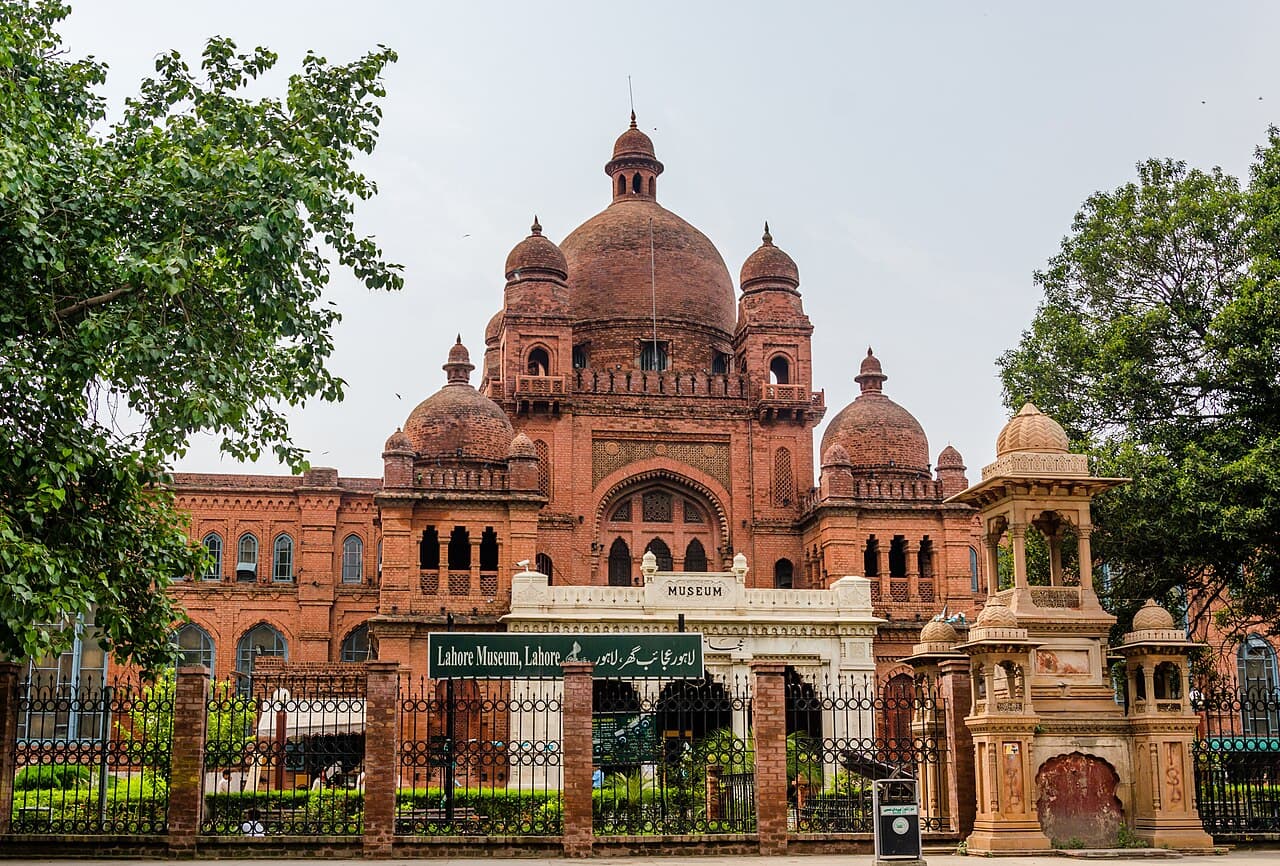
The present building opened in 1894, but the institution moved through earlier homes. Lahore Museum's background traces it from Wazir Khan's Baradari to the 1864 exhibition hall later called Tollinton Market, and then to the current purpose-built complex. It credits Sardar Sahib Bhai Ram Singh with the design and Rai Bahadur Ganga Ram with execution. John Lockwood Kipling linked the museum to the Mayo School of Art, now NCA.
Pause from public space to compare the museum facade with the neighbouring art-school precinct and Zamzama in front. The cannon is not merely street furniture: the museum records that it was cast in Lahore around 1757 and acquired the name Bhangianwali Toap during its Sikh-period history. One compact forecourt therefore holds military, educational, craft and museum histories in tension.
Sources: Lahore Museum, Government of Punjab05
Follow the education corridor without trespassing
Continue by reading institutional fronts and street relationships. The University of the Punjab says its Allama Iqbal Campus on the Mall contains the historic Senate Hall, Syndicate Room and Main Hall, as well as the Oriental College and other academic units. Government College opened in 1864, moved several times, and occupied its present building in the 1870s; the university's own building history places it amid the administrative and educational core of Lahore.
These are active campuses. Unless a current notice or staff member authorises entry, make the architecture legible from lawful public viewpoints: gates, setbacks, towers, signs and the way each institution addresses the road. A useful walk does not depend on entering every compound.
Sources: University of the Punjab; Government College University Lahore06
End according to attention, not ambition
If the museum absorbed most of the day, finish after the institutional exteriors and write down three objects you can still picture. If energy remains, return to one missed gallery rather than adding a distant attraction. A specialist in painting might substitute miniatures for coins; a visitor interested in state formation might pair the Sikh and Pakistan Movement galleries. The route is modular by design.
Do the practical checks immediately before departure: current museum opening information, temporary gallery notices, weather, and any announced road restrictions. Do not assume that a university gate is a visitor entrance or that a public-looking historic building is open. The durable part of this plan is its sequence of questions; access details are deliberately left to the responsible institution.
Useful answers
Reader questions
Can I see every Lahore Museum gallery in one visit?
You could pass through many rooms, but a useful first visit is better built around three galleries and one backup. The official directory shows a collection far broader than a single theme, so selection protects time for close looking and for the Mall Road context outside.
Sources: Lahore Museum, Government of PunjabWhich collection gives the clearest long timeline?
The Coins Gallery is the most compact chronological route because its cases represent many ruling traditions over a long period. Pair it with one object-rich narrative gallery, such as Gandhara or Sikh, so the visit is not only dates and rulers.
Sources: Lahore Museum, Government of PunjabDoes this plan require entering NCA, Punjab University or GCU?
No. It works as an exterior civic walk. These are teaching institutions, not guaranteed tourist sites, so consult their current rules if you have a legitimate reason to enter and otherwise observe from public space.
Sources: University of the Punjab; Government College University LahoreWhat should I drop if the day runs late?
Drop an optional gallery or the furthest institutional exterior, not the pause outside the museum. The relationship among the museum, former Mayo School of Art and Zamzama is the key transition from collections to city history.
Sources: Lahore Museum, Government of PunjabRead the evidence
Sources and further reading
These sources support the relevant sections above. Plans and comparisons are editorial suggestions. Check operators for current arrangements.
- Gallery | Lahore Museum ↗Lahore Museum, Government of Punjab · Research date 14 September 2026
The official list of museum galleries and the range of collections available for a selective visit.
- Gandhara Gallery | Lahore Museum ↗Lahore Museum, Government of Punjab · Research date 14 September 2026
The gallery's narrative reliefs, materials and named collection highlights.
- Coins Gallery | Lahore Museum ↗Lahore Museum, Government of Punjab · Research date 14 September 2026
Collection scale, represented ruling traditions and named coin highlights.
- Background | Lahore Museum ↗Lahore Museum, Government of Punjab · Research date 14 September 2026
The museum's former locations, present building, designers, NCA connection and Zamzama history.
- Allama Iqbal Campus ↗University of the Punjab · Research date 14 September 2026
The historic halls and academic units located at the university's Mall Road campus.
- History of GCU Building ↗Government College University Lahore · Research date 14 September 2026
Government College's founding, earlier locations and move to its present building.